Showing posts with label persistence. Show all posts

18 August 2021

UNDERSTANDING HUMAN BEHAVIOR: Mindset

"If at first you don't succeed, try, try again. Don't give up too easily; persistence pays off in the end." (Thomas H. Palmer) 

"I can accept failure.  Everyone fails at something.  But I can't accept not trying." (Michael Jordan)
"Failure is so important.  We speak about success all the time.  But it is the ability to resist or use failure that often leads to greater success."  (JK Rowling)
"It's not that I'm so smart.  It's just that I stay with problems longer." (Albert Einstein)
"Success is the ability to go from one failure to another with no loss of enthusiasm." (Winston Churchill)
"Our greatest weakness lies in giving up.  The most certain way to succeed is always to try just one more time." (Thomas Edison)

What do each of these successful individuals have in common?  They share an understanding of what they're capable of, view failures as learning opportunities, and the willingness to keep trying until they get it right.  They each have a growth mindset.  


Dr. Carol Dweck, the researcher and expert on developing this concept, explains a growth mindset is the belief that all abilities are trainable...they can be learned. That nothing is fixed.  That we can change everything--intelligence, creativity, athleticism, and even our character--through persistent and adaptive effort. 
At the other end of this spectrum is a fixed mindset, which assumes that our character, intelligence, and creative ability are predetermined--we're born with them--and can't be changed. Success, then, is the proof of that inherent intelligence, an assessment of how those givens measure up against an equally fixed standard. Striving for success and avoiding failure at all costs become a way of maintaining the illusion of being smart or talented.
A significant portion of our behavior comes from these two mindsets, along with our relationship with success and failure in both professional and personal contexts, and ultimately our capacity for happiness.
Do people with a growth mindset believe that anyone can be anything, that anyone with proper motivation or education can become Einstein, Beethoven or Kobe Bryant?  No, but they believe that a person's true potential is unknown--that it's impossible to foresee what can be accomplished with years of passion, perseverance, hard work, and training.

What makes the growth mindset so appealing is that it creates a passion for learning rather than a hunger for approval. 

At its core is the belief that human qualities like intelligence and creativity, and love and friendship can be cultivated through effort and deliberate practice. Not only are people with this mindset not discouraged by failure, but they don’t actually see themselves as failing in those situations — they see themselves as learning. 

Dr. Dweck quotes a seventh-grade girl, who captured the difference between the mindsets beautifully:

I think intelligence is something you have to work for.  It isn't just given to you.  Most kids, if they're not sure of an answer, won't raise their hand to answer the question.  But what I usually do is raise my hand, because if I'm wrong, then my mistake will be corrected.  Or I'll raise my hand and say, "How would this be solved?" or "I don't get this. Can you help me?"  Just by doing that, I'm increasing my intelligence.

14 April 2020

POSITIVE ATTRIBUTES: Persistence


If little babies believed that giving up was an option when learning how to walk, we'd all be crawling around on our hands and knees.  

Have you noticed, though, that babies NEVER give up?  They try, fall down, cry, and get back up.  They stand, make adjustments with  how they balance their weight, how far to step forward, and so on.  It's the getting back up and trying over and over again that makes it possible to walk.  Babies don't give up just because they don't walk perfectly the first time they try.  Or the second.  Or the third.  They just keep going until they get it right.

But a lot of us throw in the towel when things challenge us more than we expect they will.  Some of us have the belief that if something doesn't come easy, it's not worth our time or energy to see it through to the end.  How many unfinished projects do you have?  How many times have you tried something new and immediately abandoned it when you discovered that you had to work at getting good at it?  How many times have you thrown up your hands and given up because it just got too hard?

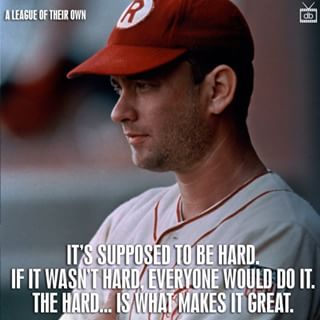
In the movie "A League of Their Own," Coach Jimmy Dugan (played by Tom Hanks) challenges his best player when she decides that she's quitting baseball because it would mean making some difficult personal sacrifices:

But Where Are the Readers? | New Author Publishing

What I'm talking about is persistence. It's defined as "perseverence in spite of fatigue or frustration."  It's sticking with something no matter how tired you are or how much you really want to quit. It's a personality trait successful people have that causes them to keep going with a task no matter what and not giving up.

Persistence is the ability to stick with something and see it all the way through.  Think back to when you were learning how to ride a bike.  When you fell down or lost your balance, you kept on going until you got the hang of it, right? That's persistence.

Pursuing a college degree is no different.  There are courses and topics and skill sets to be learned that are designed to get you to the career you dream about.  Some come easier than others.  The harder tasks try your patience.  You might even question whether you've chosen the right course...or career.  The difference between success and failure is to not give up.

Just because something is difficult doesn't mean you shouldn't be doing it.  College is supposed to be hard.  If it wasn't hard, everyone would do it. The hard...is what makes college great.

Welcome to the Counselor's Desk

Welcome to the Counselor's Desk

I've been a Licensed Mental Health Counselor in New York State since 2000, and over the years my clients have struggled to understand wh...